STEREOSCOPIC IMAGES FOR VISUALIZATION OF CULTURAL
HERITAGE
[ Stereoscopic Vision |
Image Separation |
Photos & Computing |
File Formats |
References ]

 Bildergalerie
Abstract
The usage of stereoscopic images covers a wide range of applications of computer visualization. Those can be entertainment, medical and forensic applications, topographic mapping or architecture. In all cases stereoscopic displayed data is far more effective for visualization then a flat presentation. Monoplotting from stereo pairs by means of correlation seems to be one of the major advantages of digital photogrammetry. Displaying the results in stereo with standard equipment on a PC-Workstation is one step more for a better acceptance of photogrammetry.
This contribution focuses on some aspects of stereoscopic image handling in a computer environment and the distribution of stereo pairs via the Internet.
1 Stereoscopic vision
The lens of a human eye projects a two dimensional image of spatial objects onto the retina. In case of monoscopic viewing special features of experience like geometric perspective, size of objects or overlapping provides some spatial imagination. The result of monoscopic depth detection cannot reach the quality of binocular depth perception.
The two images, human eyes receive, are due to the eye distance different from each other. The two perspectives result in a spatial imagination depending on the integration ability of the human viewing system. Basic of stereoscopic vision is the comparison of those different perspectives. A physiological value for sensation of depth differences is the disparation, which is known in photogrammetry as the stereoscopic parallax.
Detecting depth differences decreases with the square of the distance from the observer to the object. Capacity is very high close to the observer. Extending the stereo basis and enlargement of images can increase the stereoscopic imagination. Under this circumstances naturalness will loss.
Spatial imagination can be produced if images, which fulfil the requirements to natural viewing are displayed separately to the according human eye. Perspective projections with parallel viewing directions and identical image content are required.
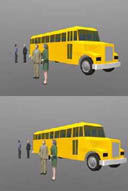
The above condition is mentioned as the normal case of stereophotogrammetry. Those images can be taken as photographs if the object is an existing one or in case of virtual reality with photorealistic renderings. Figure 1 presents such a stereo pair of a virtual scene.
